Medal Muddle

medal

We really enjoyed working on the following puzzle from Nrich.

Thirteen nations competed in a sports tournament. Unfortunately, we do not have the final medal table, but we have the following pieces of information:

1. Turkey and Mexico both finished above Italy and New Zealand.

2. Portugal finished above Venezuela, Mexico, Spain and Romania.

3. Romania finished below Algeria, Greece, Spain and Serbia.

4. Serbia finished above Turkey and Portugal, both of whom finished below Algeria and Russia.

5. Russia finished above France and Algeria.

6. Algeria finished below France but above Serbia and Spain.

7. Italy finished below Greece and Venezuela, but above New Zealand.

8. Venezuela finished above New Zealand but below Greece.

9. Greece finished below Turkey, who came below France.

10. Portugal finished below Greece and France.

11. France finished above Serbia, who came above Mexico.

12. Venezuela finished below Mexico, and New Zealand came above Spain.

We came up with different strategies to sort out the medal table, and we were largely successful eventually, but we were all impressed by a quick way to solve it!


Humble-Nishiyama Randomness Game

cards

We played a two player strategy game today, using all the information from +plus magazine.

The game is played as follows. At the start of a game each player decides on their three colour sequence for the whole game. The cards are then turned over one at a time and placed in a line, until one of the chosen triples appears. The winning player takes the upturned cards, having won that “trick”. The game continues with the rest of the unused cards, with players collecting tricks as their triples come up, until all the cards in the pack have been used. The winner of the game is the player that has won the most tricks. An average game will consist of around 7 “tricks”.

e.g. Player 1 picks RRB, Player 2 picks RBB and see who wins.

The question we thought about was:

  • Is it just a game of chance, or if you are choosing second, could you improve your chance of winning?

There is a related game called Penny’s game, using Heads and Tails of a coin toss instead of playing cards. In this version, you just play until one person has won a “trick”. We worked out some of the odds given in the first table in this article.

We ended up having to sum a geometric series! Great fun!

8 Queens Problem

queens

Welcome back everyone!

Our first puzzle this year was to place 8 queens on a chessboard such that none of the queens could take any of the others. Above is a fail – only 5 queens are on the board and they are no places left to put any more.

Here is H.B.Meyer’s website – try for yourself to fit 8 queens on the board, it is possible!

We then looked at changing the size of the board from an 8 by 8 to smaller sizes, e.g. can you fit 5 queens on a 5 by 5 board? Here is a place to try this. And if so, how many “unique” solutions are there? We defined a unique solution as being one that did not look like any others we had found when we rotated our paper or put it up to the light so it appeared flipped!

There is a great numberphile video  on this puzzle, and all the answers for different size boards on wikipedia.

Chaos Game

On a piece of paper, draw a triangle (any triangle -right angled, equilateral, isosceles, scalene). Colour one of the vertices red, the second blue, and the third green.

Next, take three dice – one red, one blue, and one green.

Now draw a point in the triangle. This point is the seed for the game. Then roll the die. Whichever die shows the highest number (throw again if there is a tie for the highest), draw a point halfway inbetween the seed and the appropriately colored vertex. Now do the same, using your new point as the seed for the next. After a few rolls you might have a drawing like this:

seed

Now continue in this fashion for five rolls of the dice. Then rub out all the points except the most recent seed and the coloured points.

Now carry on but don’t erase any points.

Can you guess what pattern your points are going to make? You might be surprised!

You might want to use technology to help you find out. Here are some instructions for using geogebra.

Jumping Frogs

frogs

The aim of this puzzle is to switch the red frogs with the blue frogs according to the following rules:

  • The left set of frogs can only move right, the right set of frogs can only move left.
  • Frogs can move forward one space, or move two spaces by jumping over another counter.
  • The puzzle is solved when the two sets of frogs have switched positions.

How many moves does this puzzle take?

How about if we change the number of frogs? Can you find a rule for the number of moves it will take based on how many frogs there are?

NRich has an applet with nice graphics here, but you are allowed to go backwards in their version, so it is is best to use this one to help you count the moves.

For interested facilitators extra notes and the solutions are here.

Venn diagram mystery

john venn

Today we solved an intriguing homework riddle with the help of a Venn diagram.  We had clues such as

“Seven students in total have Maths homework but Miya isn’t one of them.”

and

“Rory has more homework than Aidan.”

Using all the clues, which you can find here, we were able to work out which students had which pieces of homework.

It was a nice challenge! The solution can be found here. This activity was originally found on the TES website.

Name that Polynomial

This game is thanks to David Bedford at the BCME Conference in Warwick.

One person writes down a polynomial with positive integer coefficients. Call it f(x) They then choose an integer that it bigger than all their coefficients. Call it n. They then calculate f(n) and give just n and f(n) to the second person.

The second person should be able to name that polynomial! How?

Example:

Given only n=8 and f(n) = 6855 how could you work out that the polynomial was

?

It might help to think about an example when n=10 first.

The third challenge – number spellings

Hello everyone … we hope you will enjoy working on the problem below from the UK and Kenya! Please post your comments below.

First think of an integer written out in letters e.g. sixteen.

Take the number of letters in this number e.g. 7

Write this number out e.g. seven

Take the number of letters in this number e.g. 5

Write this number out e.g. five

Take the number of letters in this number e.g. 4

Write this number out e.g. four

Now we have converged to the number four.

Try this process with other numbers and see what happens.

Is it the same in other languages?

You may want to use the power of Python programming language to explore this further. You can make the Trinket below fullscreen by clicking on the three parallel lines in the top left corner and then clicking fullscreen (and do this again to stop it being fullscreen).

What day of the week …

… will the 28th of July 2061 be?  (Next predicted sighting of Halley’s comet)

… was the 4th of April 1965? (Robert Downey Jr ‘s birth)

… was the 17th of July 1789? (Prise de la Bastille)

We puzzled over these two questions having to think about where to start, the number of days in each month, and the rules for leap years.

It was fun to try different strategies by hand, but then we used the mod function and the floor function in Zeller’s algorithm to find quickly the day of the week for any date.

days of the week

Chaos Theory

rabbits

Today we explored one of the most famous recursive sequences called The Logistic Map.

logistic map equation

Try this activity leading on to exploring the sequence on Geogebra. There are Geogebra instructions here if you get stuck.

We were inspired for this activity by this amazing video from Ben Sparks on Numberphile. It explains how this activity links to one of the Feigenbaum constants, pseudo ramdom numbers and Chaos Theory. Definitely worth watching!

Möbius Bands

mobius

The first question of today is how many sides a piece of paper has. So the answer is 2 of course. Now we want to find a way of folding the paper in such a way that there is only one side. One way to verify this is to take a pen and colour the folded piece of paper. If you do not need to turn the piece of paper around, there is only one side. The method to do this is to twist the piece of paper by half a turn and you will obtain a möbius band.

This is all explained in this presentation from Suffolk maths, that also contains a brilliant exploration table. Your challenge is to fill in the first three lines and to come up with three other results to add to the table below.

mobius table

Good luck!

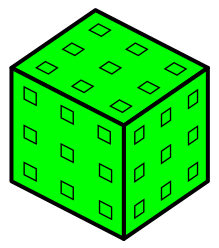
Cube buildings

cube building

We used this website to solve a series of challenges where you start with front, side and top elevations to build the full picture of 3D shape – building up to using only two views and silhouettes.

Notes on the website
– You need to click once for adding a cube and hold the clicker down a bit longer to clear.
– When you press check, the tick is red if it is wrong, yellow if it works, but there could be fewer cubes, and green when it is correct and the minimum number of cubes have been used.

Tennis odds

In pairs we played the following game a couple of times.

One person is heads (player 1), the other person is tails (player 2). Toss the coin a maximum of 10 times, player 1 gets a point if the coin lands on heads, and player 2 gets a point if the coin lands on tails. If one person becomes three points ahead of the other the game stops and they win. If no one is 3 points ahead after ten tosses the game is a tie.

Which of the following scores are impossible in this game and why? 5-2, 7-4, 6-2

Think of ways the game could end in a tie.

What is the chance of winning this game?

This following table will help.

coin toss table

Fill in the table shading out impossible final scores, highlighting winning final scores for Player 1 and Player 2, and highlighting final scores which indicate a draw.
Then write in each box how many ways there are to end up at each score.

A few boxes have been filled in – for example 3-0 is a winning score for player 1, and there is only 1 way to get to that score (1-0 then 2-0 then 3-0). There are two ways to get to a score of 1-1 (0-1 then 1-1 or 1-0 then 1-1). There is a 1 in the 0-0 box as there is just one way to start the game.

See  here for the solution, contained in an excellent presentation by Alex in the Further Maths class in PAL. This puzzle is the starting point for analysing how likely you are to win a tennis match if you only have a one third chance of winning each point. The idea and diagrams in the presentation were taken from the book Game, Set and Math by Ian Stewart.

Egyptian Fractions

Unit fractions are fractions that are written in the form 1⁄n.

Today’s challenge is to find sums of different unit fractions that are equal to another unit fraction.

For example: 1⁄2 = 1⁄3 + 1⁄6

Let’s see if there is a rule: which of the following are right and which are wrong?

1⁄2 = 1⁄10 + 1⁄20

1⁄3 = 1⁄4 + 1⁄12

1⁄3 = 1⁄7 + 1⁄21

1⁄4 = 1⁄5 + 1⁄20

The next challenge is to spot the pattern in these sums of unit fractions:

1⁄6 = 1⁄7 + 1⁄42

1⁄6 = 1⁄8 + 1⁄24

1⁄6 = 1⁄9 + 1⁄18

1⁄6 = 1⁄10 + 1⁄15

Bear in mind that 1⁄6 = 1⁄12 + 1⁄12 is wrong because both unit fractions are the same.

Try and use this to example to find all the unit fraction sums that add up to 1⁄18.

What if original fraction is not a unit fraction?

Egyptians had a tendency to write fractions as sums of unit fractions.

Of course, there is an infinite number of ways to do this. Let’s take  for example.

2⁄3 = 1⁄3 + 1⁄4 + 1⁄12

2⁄3 = 1⁄3 + 1⁄5 + 1⁄20 + 1⁄12

2⁄3 = 1⁄4 + 1⁄12 + 1⁄7 + 1⁄42 + 1⁄31 + 1⁄930 + 1⁄21 + 1⁄420 + 1⁄13 + 1⁄156

Etc.

But how about expressing non unit fractions as sums of two unit fractions? Here is one example:

2⁄3 = 1⁄2 + 1⁄6

But can all fractions with numerator 2 be written as the sum of just 2 unit fractions? Can you prove it?

Let’s finish off with the greedy algorithm. This algorithm, which was developed by Fibonacci, allows you to quickly find a non-unit fraction as the sum of several unit fractions.

For example, let’s take 11⁄12. The first step is to find the largest unit fraction below the other fraction. In this case, that fraction is 1⁄2. Then, you should subtract 1⁄2from 11⁄12, which gives 5⁄12. This means that 11⁄12 = 1⁄2 + 5⁄12 .  Repeat this with 5⁄12 and you should get:

11⁄12 = 1⁄2 + 1⁄3 + 1⁄12

If you would like to learn more, you can to the NRICH website with these links:

https://nrich.maths.org/6540

https://nrich.maths.org/1173

https://nrich.maths.org/6541

Logicians

my brain hurts

Here is probably the hardest puzzle we’ve looked at so far in maths club …

Two perfect logicians, Sam and Polly, are told that integers x and y have been chosen such that 1 < x < y and x+y < 100.  Sam is given the value x+y and Polly is given the value xy.

They then have the following conversation.

Polly:  I cannot determine the two numbers.

Sam:  I knew that.

Polly:  Now I can determine them.

Sam:  So can I.

Given that the above statements are true, what are the two numbers?

Starting points:

Before Polly and Sam say anything:

What is the range of numbers Sam could be given?

What is the range of numbers Polly could be given?

What special type of number can the product of x and y never be?

What about the square of these numbers?

After Polly’s first statement:

Give two examples of products that Polly can not be given.

After Sam’s first statement:

 Give two examples of sum’s that Sam can not be given.

Next steps …

At this point you probably want to start using a computer to generate a list of numbers that they could be given.

Apples

fresh-apple-250x250

This puzzle comes from Alex Bellos’ column in the Guardian. It has been adapted from one by Prem Prakash, an electrical engineer from Bangalore, India, who has taken early retirement to develop puzzle-based teaching workshops.

You and your two friends Pip and Blossom are captured by an evil gang of logicians. In order to gain your freedom, the gang’s chief, Kurt, sets you this fearsome challenge.

The three of you are put in adjacent cells. In each cell is a quantity of apples. Each of you can count the number of apples in your own cell, but not in anyone else’s. You are told that each cell has at least one apple, and at most nine apples, and no two cells have the same number of apples.

The rules of the challenge are as follows: The three of you will ask Kurt a single question each, which he will answer truthfully ‘Yes’ or ‘No’. Every one hears the questions and the answers. He will free you only if one of you tells him the total number of apples in all the cells.

Pip: Is the total an even number?

Kurt: No.

Blossom: Is the total a prime number?

Kurt: No

You have five apples in your cell. What question will you ask?

See here for the solution.

Origami with maths

hexagon

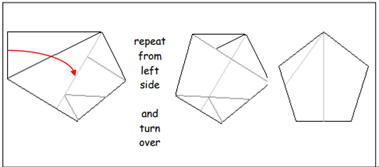
Today we looked at how we can transform a blank sheet of A4 paper into many different shapes such as an equilateral triangle and a kite. To do so you can either try to figure it out yourself or you can follow the Origami instructions for each different shapes.

If you have anymore interesting ideas please share them in the comment section below and if you want an extra challenge try proving that all of these folds actually give regular shapes bearing in mind the fact that the ratio of the sides in an A4 paper is 1:root 2

Binary Puzzles

binary

This week, we looked at three seemingly unrelated problems which all ended up being related to binary numbers.

The first is about Russian multiplication. Take, for instance 22 x 19.  Multiply the left side by 2 every time and divide the right side by 2, and do this until the right side is equal to 1. If, while you do this, you ever get a decimal number on the right side, round down to the next integer.

e.g.

 22 19
44 9
88 4
176 2
352 1

The next step is to get rid of all the lines with an even number on the right side, which leaves us with 22, 44 and 352 on the left side. Now we know that 22 x 19 = 418. What do you notice when you add 22, 44 and 352? Now try this with other multiplications. Does it still work? If it does, can you explain why it works?

Here is a website that explain this more fully:

https://www.basic-mathematics.com/russian-peasant-multiplication.html

The second problem we looked at today was all about magic cards or maths busking. Have a look at the following cards:
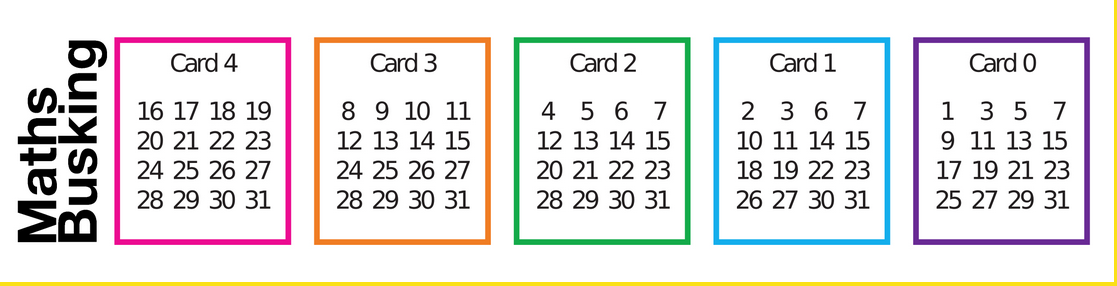
Magic cards

You can do the following trick with them. You ask someone to tell you which colour cards their birthdate appears on. You can straightaway say what their birthdate is. Can you guess how? It is not by learning all the numbers on the cards. One clue is to look at the first number in each card. Can you spot a pattern? Again, here is a website to help you:

http://www.mathmaniacs.org/lessons/01-binary/Magic_Trick/

Extension: If you add one more card, with how many more numbers can you do the trick with?

The final puzzle of today is about poisoned wine bottles. This is the story:

The King of a small country invites 1000 guests to his annual party.

Each guest brings the King a bottle of wine. Soon after, the Queen discovers that one of the guests is trying to assassinate the King by giving him a bottle of poisoned wine. Unfortunately, they do not know which guest, nor which bottle of wine is poisoned.

Just a single drop of the poisoned wine would kill the King.

The King has 10 prisoners in his dungeon. He decides to use them as taste testers to determine which bottle of wine contains the poison.

The poison when taken has no effect on the prisoner until exactly 24 hours later when the infected prisoner suddenly dies. The King needs to determine which bottle of wine is poisoned by tomorrow so that the festivities can continue as planned. Hence he only has time for one round of testing. How can the King administer the wine to the prisoners to ensure that 24 hours from now he is guaranteed to have found the poisoned wine bottle?

As we have seen with a lot of Maths Club problems, sometimes the first step is try with smaller numbers. For instance, instead of using 10 prisoners, we could say that there are 500 prisoners. So how could we test this now? Once you have figured this out, you could try with less and less prisoners. Now, we can solve the puzzle:

First, let’s line up our 10 prisoners and label them. Also label the wine bottles 0–999 so we can tell them apart.

prisoner line up

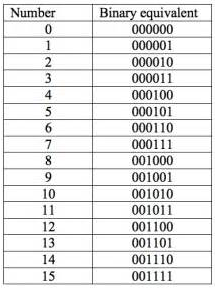
Label each bottle with both its decimal number and binary equivalent.

decimal=binary
0=0000000000
1=0000000001
2=0000000010
3=0000000011
4=0000000100
5=0000000101
6=0000000110
7=0000000111
8=0000001000
9=0000001001
10=0000001010

etc

Now each bottle serves as a code describing which prisoners are to drink from it. In this system, a one means the prisoner drinks from it, a zero means the prisoner doesn’t.

For example, only Prisoner J should drink from bottle one since its binary is 0000000001. Whereas, Prisoners I and G should drink from bottle ten whose binary is 0000001010 because it has 1’s in the columns that match up with prisoners I and G.

Continue this process until you have given out sips of wine from every bottle. After 24 hours, line up the prisoners in order and note which ones have been poisoned with ones and mark the rest with zeros. Convert this number back into decimal to reveal which bottle was poisoned.

Extension: If there were 2000 bottles, how many prisoners would you need?

If you would like to learn to learn more about binary, check out this website:

https://www.mathsisfun.com/binary-number-system.html

Counting Lattice Paths

counting lattices

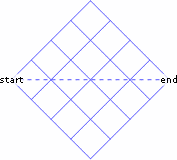
This week’s problem is all about counting the number of paths from one point to another on a 4 by 4 grid.

You can only travel in these directions

directions lattice

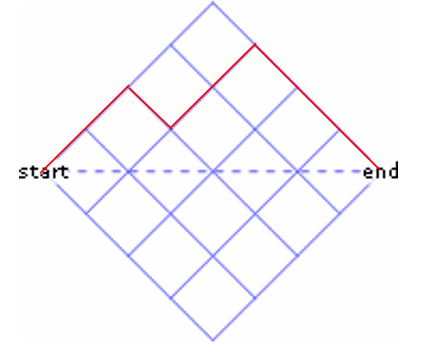
Here is one acceptable path:

sample path

So how many such paths are there? First off, in which of these ranges do you think the answer lies:

< 20
20 – 40
40 – 60
60 – 80
80 – 100
>100

A first tip on how to solve this is to look at what is going on with smaller grids. Why don’t we start with a 1 by 1 grid? How many different paths are there between the starting point and the end point? Once we have done that, we can place the data on our larger grid.

After doing this a few times, does a pattern start to emerge?

Here is a website that shows all the solutions and an explanation of how the problem works, if you would like to learn more.

http://www.robertdickau.com/lattices.html

River crossing puzzles

wolf

You are on one side of a river, and with you, there is a wolf, a goat and a cabbage. You have one boat, and can only take one living thing at a time. The goat cannot be left alone with the cabbage and the wolf cannot be left alone with the goat. How many journeys must you do in minimum to get all the objects to the other side of the river? In how many different ways can you do it?

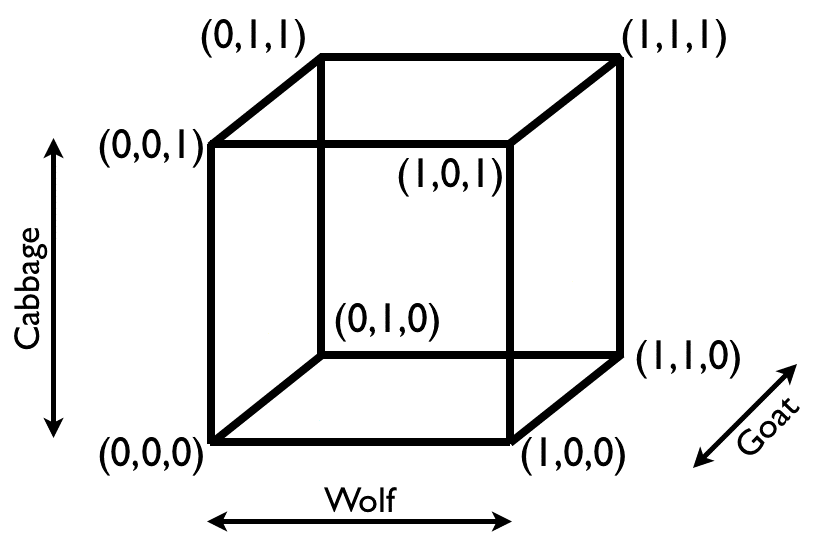
Here is a very interesting way to look at the problem which involves representing the problem in 3D wolf/goat/cabbage space.

wolf cube

The problem is then changed to getting from one vertex of the cube to another.

Finally, we looked at another river crossing puzzle, this time involving wildebeest and lions. This puzzle is fully explained and answered in this Ted-Ed talk.

Before looking at how they propose to solve the puzzle, how did you go about solving it?

Benford’s Law

benfordface-e1453738647851

The first task of today was if numbers were chosen at random, what would be the probability that numbers started with the digits 1 to 9. Of course the probability would be the same for each digit.

Ok, let’s see if this works. Go ahead and find any article, it can be a news article, a scientific article, etc. Now count the number of times that each digit 1 to 9 is at the start of a number. Does the distribution seem even?

Let’s see if this trend can be found in mathematical sequences too. Here’s an example: the Fibonacci sequence.

1,1,2,3,5,8, …

Let’s find the probability of numbers starting with digits 1 to 9 in the first 10,000 numbers of this sequence.

Quick tip: you can use excel to do this and then use the countif function to find the distribution of probabilities of numbers that start with each digit. Does the distribution seem even?

Excel first digit

Excel countif

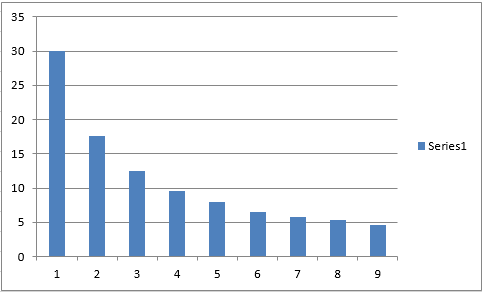
This strange pattern of occurrence is called Benford’s law, and it is very counter-intuitive.

benford graph

If you would like to learn more, click on this link: https://brilliant.org/wiki/benfords-law/

So here is your final challenge: every single time you see a number today, write it down and you can then verify the law for yourself. How close did you get?

Mastermind problems

mastemind

Welcome back to Maths Club!

Today, we looked at a few logic problems based on the popular game, Mastermind. If you have never played it before, you can try online here.

We then answered these interesting questions  about what you can deduce from certain opening moves.

For the answers to these questions and some of the mind bending maths behind Mastermind, have a look at this paper by Tom Davis.

Voting systems

voting

Finding betting ways to vote

We looked at different ways to decide which candidate or choice won a vote. We realised that by using different methods, different candidates won the vote. This raises the troubling question about whether our way of voting is the best and the fairest. Here is a link to the activity we did and here is a link to an interactive website that discuss precisely this question. In the UK, the voting system is relative majority. However, it could be a good thing if we use absolute majority voting, because it would allow members of smaller parties to also get a voice. This could lead to a bigger number of parties rather than two or three major parties. However, there is no perfect voting system.