We played a two player strategy game today, using all the information from +plus magazine.
The game is played as follows. At the start of a game each player decides on their three colour sequence for the whole game. The cards are then turned over one at a time and placed in a line, until one of the chosen triples appears. The winning player takes the upturned cards, having won that “trick”. The game continues with the rest of the unused cards, with players collecting tricks as their triples come up, until all the cards in the pack have been used. The winner of the game is the player that has won the most tricks. An average game will consist of around 7 “tricks”.
e.g. Player 1 picks RRB, Player 2 picks RBB and see who wins.
The question we thought about was:
Is it just a game of chance, or if you are choosing second, could you improve your chance of winning?
There is a related game called Penny’s game, using Heads and Tails of a coin toss instead of playing cards. In this version, you just play until one person has won a “trick”. We worked out some of the odds given in the first table in this article.
We ended up having to sum a geometric series! Great fun!
This game is thanks to David Bedford at the BCME Conference in Warwick.
One person writes down a polynomial with positive integer coefficients. Call it f(x) They then choose an integer that it bigger than all their coefficients. Call it n. They then calculate f(n) and give just n and f(n) to the second person.
The second person should be able to name that polynomial! How?
Example:
Given only n=8 and f(n) = 6855 how could you work out that the polynomial was
?
It might help to think about an example when n=10 first.
Here is a cheatsheet for when you have a strategy. Can you write some Python code to work out the polynomial for you?
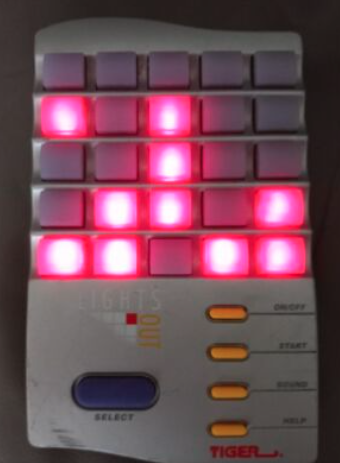
Lights Out was an electronic game released by Tiger Electronics in 1995. The game consists of a 5 by 5 grid of lights. When the game starts, a random number or a stored pattern of these lights is switched on. Pressing any of the lights will toggle it and the adjacent lights. The goal of the puzzle is to switch all the lights off, preferably with as few button presses as possible.
Here, or below, you can play a 3 x 3 version on Geogebra (courtesy of Stephen Jull and Yin Su).
One method to solve – Light Chasing
“Light chasing” is a method similar to Gaussian elimination which always solves the puzzle (if a solution exists), although with the possibility of many redundant steps. In this approach, rows are manipulated one at a time starting with the top row. All the lights are disabled in the row by toggling the adjacent lights in the row directly below. The same method is then used on the consecutive rows up to the last one. The last row is solved separately, depending on its active lights.
Here is a worksheet showing all the possibilities (effectively) for the last row. Can you solve them all, and hence solve any 3×3 grid?
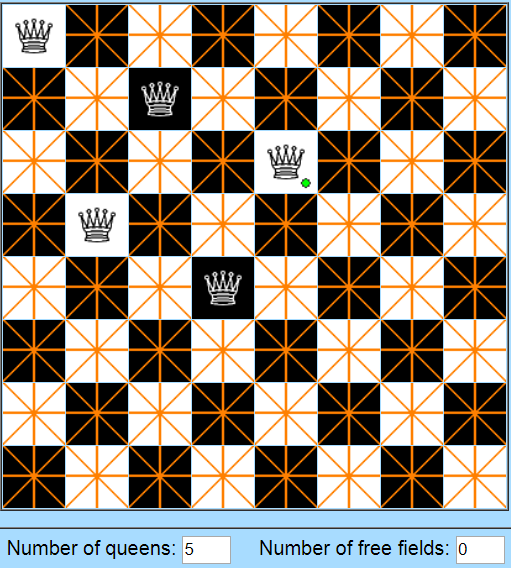
Place 8 queens on a chessboard such that none of the queens can take any of the others. Above is a fail – only 5 queens are on the board and they are no places left to put any more.
Here is a website to try yourself to fit 8 queens on the board, it is possible!
We then looked at changing the size of the board from an 8 by 8 to smaller sizes, e.g. can you fit 5 queens on a 5 by 5 board? And if so, how many “unique” solutions are there? We defined a unique solution as being one that did not look like any others we had found when we rotated our paper or put it up to the light so it appeared flipped! Here are our solutions for 5×5, 6×6 and 8×8.
There is a great numberphile video on this puzzle, and all the answers and stats you could want here.
“This is a card game I made up where you do basic mental calculations and race your opponent ( 2-4 players). Using Ace -10 cards only. Rules: 7 cards are placed face up for each player and two in the middle. The player who gets rid of their cards first wins. You can put a card in the middle (on top of either pile) when one of your cards is an answer to an expression using the two cards in the middle. eg. if 6 and 2 are in the middle possible cards that can be played are 8 (6+2) or 4 (6-2) or 3 (6 divided by 2) or 2 (6×2) – 12 is the answer but we use the last digit only. Each player has to say the expression as they put the card down. eg 6 twos are 12 – placing the 2 or 6 minus/take/sub 2 is 4. all players play on until no cards can be played. Then the dealer deals each player a card then put one on one of the two middle piles. Players then race to place cards until someone gets rid of all their cards! (4 players start with 6 cards)”
We played a few games of this and made up our own versions:
Instead of a race we played in turn – competitively or collaboratively
This activity comes from the great website mathsisfun.com.
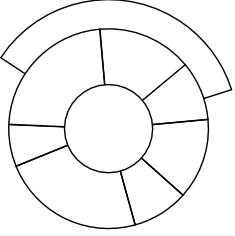
Have you ever coloured in a pattern and wondered how many colours you need to use?
There is only one rule
Two sections that share a common edge cannot be colored the same.
Having a common corner is OK, just not an edge.
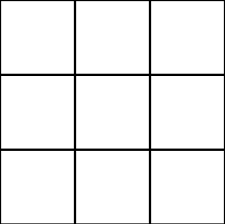
Let’s start with a simple pattern like a group of nine squares:
What is the minimum colours you need to colour the pattern of nine squares?
A Little More Complicated
How about this one?
How many colours do you need this time?
Even More Complicated
Let’s try another:
How many colours do you need this time?
Nine? Eight? Seven? Six? Five? Four?
How about this one?
Maps
Things get more interesting if we want to colour a map.
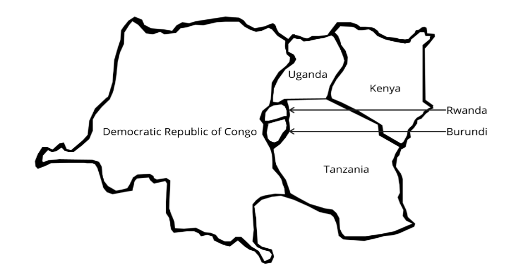
Here is a map of Africa, showing six countries and how they border on each other:
Try colouring in the map and see what is the fewest number of colours you need.
Extension
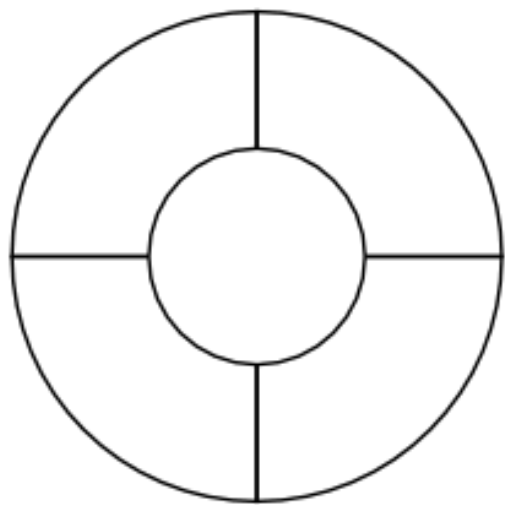
Can you draw a map with 3 countries such that every country has exactly two neighbours, and then colour it.
Can you draw a map with 4 countries such that every country has exactly two neighbours, and then colour it.
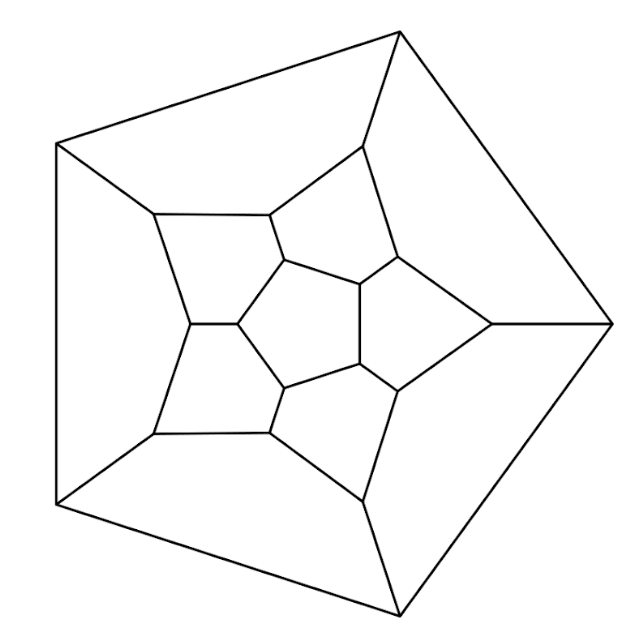
Can you draw a map with 6 countries such that every country has exactly four neighbours, and then colour it.
Can you draw a map with 12 countries such that every country has exactly five neighbours, and then colour it.
Further Reading
The proof of the four colour theorem was famously tricky, and comes from graph theory, where mathematicians investigate an equivalent problem of colouring vertices of a network so that no edge has endpoints the same colour. The original four-colour proof was attempted byAlfred Kempe in 1879, but unfortunately Percy John Heawood found an error 11 years later. However his work was not useless, as Percy was able to prove the five-colour theorem (that one can colour a map with no two adjacent regions the sample colour using at most 5 colours) based on Kempe’s work. The four colour theorem was finally proved in 1976 by Kenneth Appel, Wolfgang Haken, and John Koch using a computer to check it. This was the first major theorem to be proved using a computer. They checked around 1500 configurations using about 1200 hours of computer time. Some people were sceptical about a proof using a computer but independent verification soon convinced everyone that the four colour theorem had finally been proved.
 ?
?