
Did you know genuine snowflakes have six fold symmetry? We learnt this and more using the resources by Matt Parker here.
Did you know genuine snowflakes have six fold symmetry? We learnt this and more using the resources by Matt Parker here.

Today we worked on all our Christmas cracker puzzles.

Today we looked at ways to count on our fingers. Up to 10 is obviously straight forward, but can you do better?
We managed 1023. Can you work out how? Can you do better?
This idea came from a great maths book – Things to Make and Do in the Fourth Dimension This website link has lots of gadgets to play with.
SAMI (Supporting African Maths Initiatives) supports mathematics work across Africa, including coordinating volunteers and resources to help run yearly maths camps in Kenya, Ghana, Ethiopia and Tanzania, as well as weekly maths clubs in over 70 schools. SAMI has also helped to raise money and lend expertise to developing computer programs for statistics and education, as well as providing tablets and training to help improve livelihoods for people living in rural African villages. With some extra funding SAMI could extend their projects to more schools and communities in more countries, and travel to the most isolated areas where their support is needed most.
See here for more information about SAMI. Donations are very welcome here.
Enjoy the puzzles, Merry Christmas.
Santa can wrap all the presents in 60 minutes and Mrs Claus can wrap all the presents in 40 minutes.
How long will it take them if they do the job together?
Solution is here.
Take the total amount of presents as x. Santa will be working at a rate of x/60 presents per minute, and Mrs Claus at a rate of x/40 minutes.
By simply adding the rates together,
x/60 + x/40 = 100x/2400 = x/24,
we can find the answer, 24 minutes.
Children are sitting in a circle, and a teacher walks around the circle, giving presents. The teacher gives a blue present to every second child, and a green present every third child.
After going around four times, the sixth child from where the teacher started has two blue present and two green presents.
What is the fewest amount of children could there be?
Solution is here.
The teacher goes round the circle four times. If there was an even number of children, the sixth child would always receive a blue present and would have four blue presents at the end. Since they only have two blue presents, there must be an odd number of children in the circle.
With the same logic for the green presents the answer can’t be a multiple of 3.
The sixth child receives a green present in the first round because 6 is a multiple of 3. She only receives one more green present so the answer can’t be a multiple of 3.
The options are 7, 11, 13, 17, 19 … and so 7 is the fewest number of children.
Three bells ring on Christmas Day.
The first bell rings every 6 minutes,
The second bell rings every 14 minutes,
The third bell rings every hour.
If all the bells ring together at noon, at what time will they next all ring together?
Answer is here.
The lowest common multiple of 6, 14, and 60 is 420 (7×6×10). So 7 hours after noon.
7pm is the answer.
Matt, Noah, Olivia and Penny are at the Christmas market.
A Christmas tree seller is selling decorated and undecorated trees.
There is one more decorated tree than undecorated tree.

Matt says that the number of decorated trees is prime.
Noah says the total amount of trees is more than 8 and less than 12.
Olivia says that there are 4 undecorated trees.
Penny says that Olivia or Noah are lying.
Only one of the four are lying.
How many trees are there?
Solution is here.
There must be 4 decorated trees and 5 not decorated.
The first assumption that can be made is that either Penny, Olivia or Noah are lying, because if Penny is lying, everyone else is truthful, and if Matt is lying, Penny states that Noah or Olivia are also lying, so either one of those three are lying, which means there are too many liars.
Therefore, we have two truths: there is one more decorated tree than undecorated, and the number of trees is prime, what Matt says. Starting with all primes smaller than ten, there could be 2 undecorated and 3 decorated trees, 4 undecorated and 5 decorated trees, or 6 undecorated and 7 decorated trees.
If Olivia is telling the truth, the total is 9 (4+5) , which also means that Noah is telling the truth ( 8 < 9 < 12), and Penny is lying. In the other cases, both Noah and Olivia must be lying at once(2+3 < 8 and 6+7 > 12, none of these possibilites contain 4).
The only possible solution is when Penny is lying, and we’ve seen that in this scenario, there are 5 decorated trees and 4 undecorated trees.
You could solve this by simultaneous equations, but there is a quick way to do it without working out how much each present costs.
Add together all the amounts – this will give you double the cost as each colour present appears twice. Then just divide your answer by 2.
(£22+£15+£16+£32+£37)/2 = £61
 Five presents were bought for Christmas
The red and purple presents together cost £22
The purple and blue presents together cost £15
The blue and gold presents together cost £16
The gold and green presents together cost £32
The green and red presents together cost £37
What is the total cost of all 5 presents?
Solution is here.
The possibilities are:
(Wins, draws, goals)
Rudolphs: (0, 0, 8) or (0, 1, 3)
Comets: (0, 0, 14) or (0, 1, 9) or (0, 2, 4) or (1, 0, 4)
Vixens: (0, 0, 9) or (0, 1, 4)
If there were 3 games, then there would be 30 points
for wins and draws, leaving just 1 point for goals,
so that is not possible, since each team scored in each game.
Thus, there were only 2 games,
yielding 20 points for wins and draws, 11 for goals,
which reduces the possibilities to
Rudolphs: (0, 1, 3)
Comets: (0, 2, 4) or (1, 0, 4)
Vixens: (0, 1, 4)
Rudolphs had a draw (and maybe a loss).
Comets had 2 draws or a win and no other match.
Vixens had a draw (and maybe a loss)
If Comets had 2 draws, then both games were draws,
but that is not possible since total goals was 11, which is odd.
So Comets had a win against one of the others,
and the other game was a draw between the Rudolphs and the Vixens.
The score of Rudolphs-Vixens draw then was either 1-1, 2-2, or 3-3
Since Vixens scored more goals than Rudolphs, they
are the ones who lost to Comets, and Rudolphs, only playing once,
scored all 3 goals in that game, equalling Vixens.
Comets scored all 4 of their goals in their only game, where
Vixens scored one additional goal.
The results were:
Comets 4, Vixens 1
Rudolphs 3, Vixens 3
Snowman had never fully understood the points system in football, and felt that the scoring of goals should be encouraged. His idea is that 10 points should be awarded for a win, 5 points for a draw and 1 point for each goal scored, whatever the result of the match.
This was tried with three teams: Rudolph, Comet and Vixen.
Each team scored at least one goal in every match and no team played another more than once.
Rudolph scored 8 points, Comet 14 points and Vixen scored 9 points.
Find the score in each match.
Solution is here.
It can be proven that there are no integer (whole number) solutions to
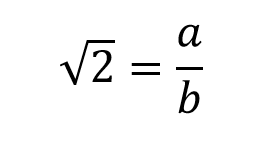
So there are no integer solutions to
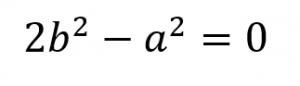
But can you find positive integer values of a and b that nearly work? That give the answer 1 or -1?
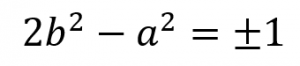
Can you find a pattern to all your solutions?
What does a/b give a good approximation to?