We are counting in whole numbers always starting at the number 1.
1,2,3,4, …
Schur numbers tell you the highest number that you can count to using k different colours before you’re forced to have an all same-coloured solution to a + b = c.
Example
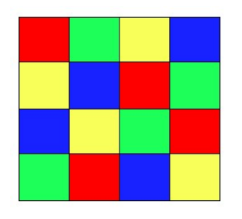
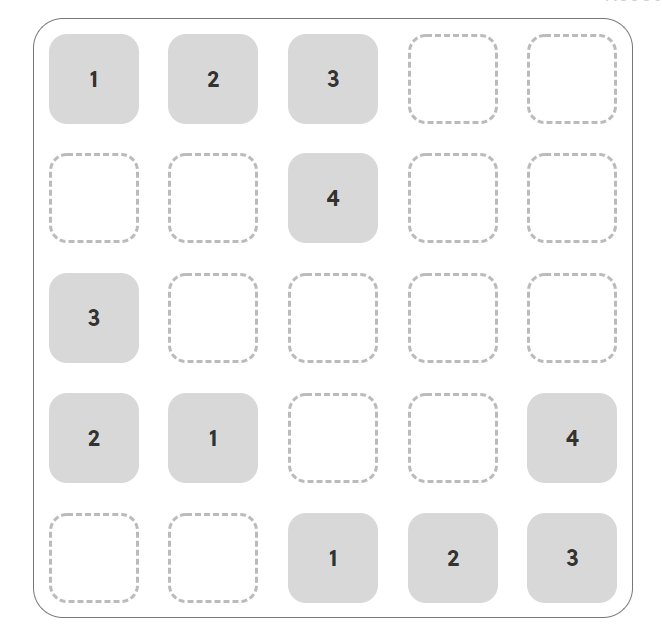
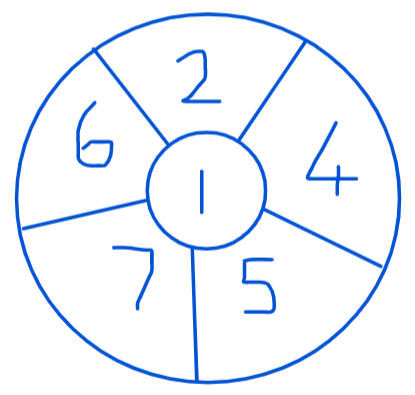
Is this a valid colouring for k = 3 (3 colours)?
No, because 2 + 2 = 4, 1 + 5 = 6 and 1 + 6 = 7 and same coloured sums are not allowed.
Challenge
For 1 colour, let’s say red, we can only count up to the number 1 like this:
1
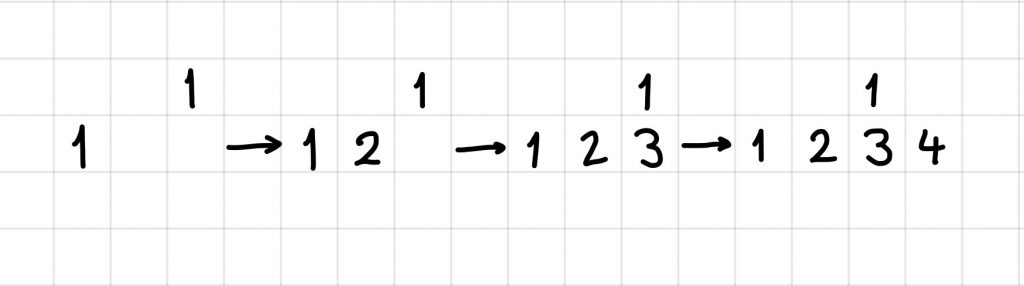
For 2 colours, let’s say red and blue, we can count up to 4 like this:
1 2 3 4
Can you explain why we can’t add the number 5?
What is the highest number you can count to using 3 colours?
You can check solutions here:
Here is a python program that generates all the solutions:
This investigation is based on the ancient Greek Apollonius Problem: Can you draw a circle that just touches three given circles? How many can you draw?
We tried this by hand and then on Geogebra following these instructions.
The maximum number of circles possible was unsolved for more than 2000 years, but we solved it! For the solutions and more see the links below:
Thanks to Barasa in Kenya for telling us about this one …
Challenge 1
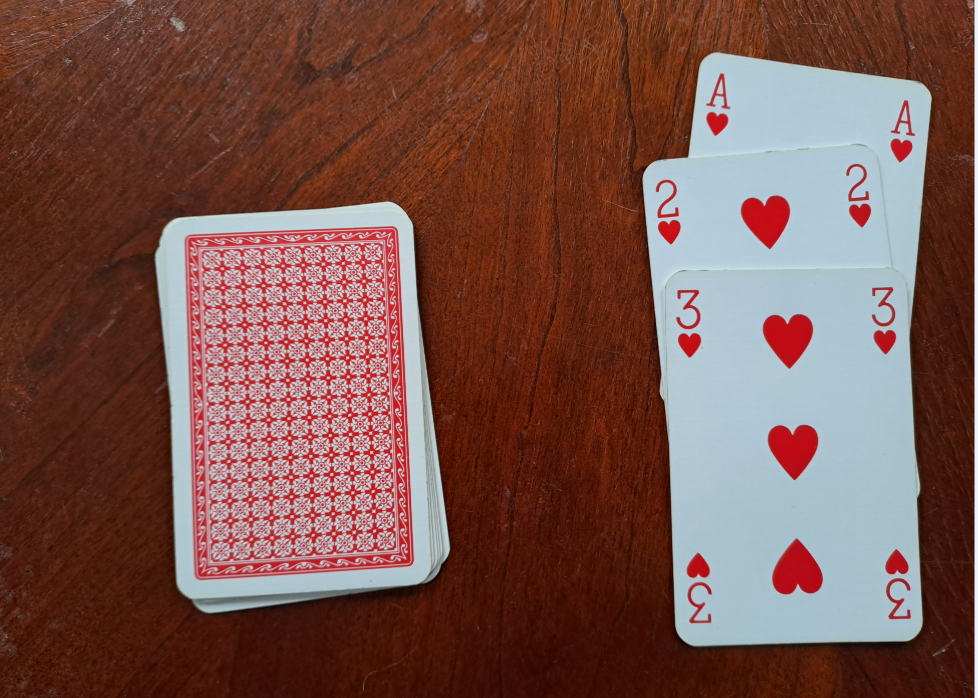
Take 10 cards from a deck – A,2,3, … 10. Ace represents 1.
Arrange the cards in a pile face down so that when you show the first card it is the Ace. Remove this card. Then count to two putting the first card on the bottom of the pile. The second card should be the two. Show it and remove it. Then count to three, each time you say a number you should be putting a card on the bottom and then when you get to 3 you show the 3 and remove it from the pile.
Arrange the cards so that this works for every number from A to 10. By the time you get to 9 you should only have two cards left in your hand! Cycle through them counting 1, 2, 3, … 9 and show the 9. And then you just have 10 left and the trick is over.
Challenge 2
Try to arrange the cards to perform the same trick except you don’t remove the card when you show it. The card is just placed at the bottom of the pile and you start counting the next number.
You should find out that this is impossible for 10 cards. Is there a number of cards that it would work for?
We tried a dice puzzle today set a while back by Matt Parker.
You only have the tool above – three dice inside a cube.
But you want to play a game that requires throwing a single dice and then a game that requires throwing two dice and adding their score together. Is there a way that you can use the sum of these three dice to simulate both of these scenarios?
Task 1
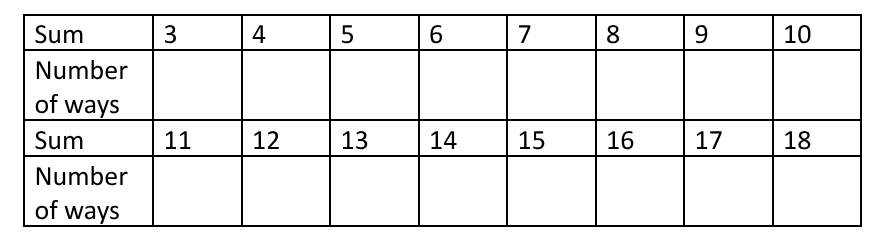
First work out the distribution of numbers you can score with three dice
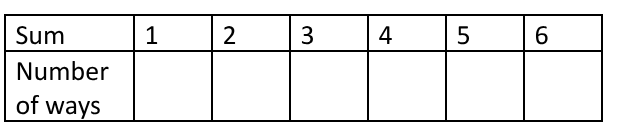
Can you map this in a nice way to the distribution for 1 dice?
The Irish logarithm is an algorithm invented by Percy Ludgate in 1909 for multiplying single-digit numbers. The idea was to program a computer to do these calculations. The algorithm uses two tables to perform the multiplication. With just these tables you can calculate products up to 9×9 simply by adding two numbers together.
Here are blank versions of the two tables below (and as a pdf).
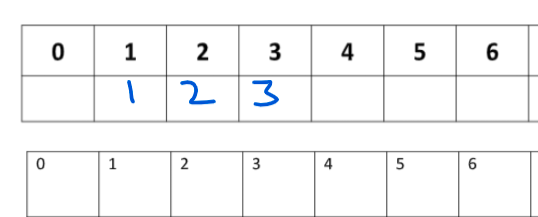
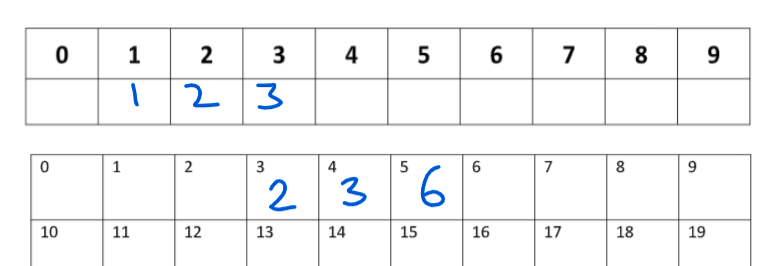
Our challenge was to fill in these tables. Here is the start of an attempt that would not work …
1 x 2 would be 1+2 so the correct answer of 2 needs to be in the box called 3.
1×3 would be 1+3 so the correct answer of 3 needs to be in the box called 4.
2×3 would be 2+3 so the correct answer of 6 needs to be in the box called 5.
So far so good ….
But … 2×2 would be 2+2 so the correct answer of 4 needs to go in the box called 4. But the box called 4 already has a 3 in it, so our initial choice of numbers is a bad one.
Can you do better?
It is very difficult to come up with the solution from scratch (but do try!). Here are a few numbers already filled in, if you would like a starting point (and as a pdf).
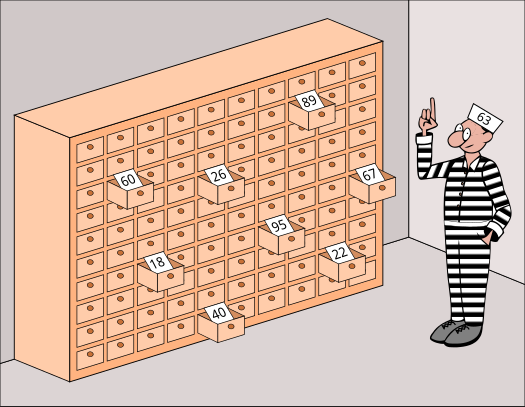
“The 100 prisoners problem is a mathematicalproblem in probability theory and combinatorics. In this problem, 100 numbered prisoners must find their own numbers in one of 100 drawers in order to survive. The rules state that each prisoner may open only 50 drawers and cannot communicate with other prisoners after the first prisoner enters to look in the drawers. At first glance, the situation appears hopeless, but a clever strategy offers the prisoners a realistic chance of survival.
Anna Gál and Peter Bro Miltersen first proposed the problem in 2003.”
In maths club we tried this problem with just 10 prisoners. You can read about the strategy here.
We analysed the percentage chance of winning by looking at the different possible cycles for 10 prisoners.
There are twelve identical looking islanders and a seesaw. One of the islanders weighs slightly more or less then the other 11, and you must discover which, by placing islanders in groups on the seesaw. However only three measurements are allowed.
You can test your method with this app:
One solution is discussed here, and then another more elegant solution is here.
We found this activity on Nrich and it was originally in one of Brian Bolt’s books and developed by MEDIAN in their collection of interesting number resources.
This Daisy is special because you can make every number from 1 to 25. You are only allowed to add neighbours (numbers touching each other) and you can only use each number once in a sum.
Can you do better than this with a different set of numbers? The challenge is to find six numbers to go in the Daisy from which you can make all the numbers from 1 to a number bigger than 25.
You can check your ideas here:
Could you adapt the program above to search for a higher solution?
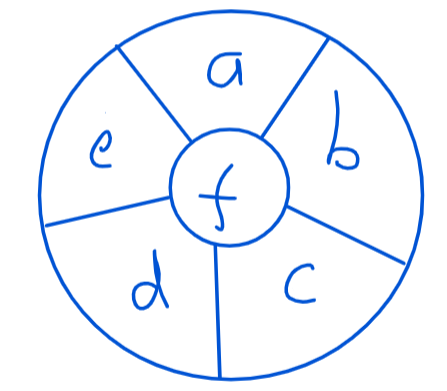
To write the program above we needed to find all the combinations from a general daisy like this:
For example you can have a+b or a+f but not a+d. Can you find all the combinations? There is a worksheet to fill in here (with the solution on the second page). An editable version is here.
On dotted paper we explored circles of different radius, counting the dots on or inside the circle. Brilliantly the number of dots is very close to the area of the circle.
We wrote this program in Python to check the ratio of dots to area for different size circles.
Challenge 1 Imagine you have an endless supply of 5p and 7p coins. You could make exactly 20p with four 5p coins. Or you could make exactly 19p with two 7p coins and a 5p coin.
What is the biggest amount that you cannot make? Can you explain why you can make all amounts after this one?
Challenge 2 The biggest number you cannot make given coins of value x and y is called the Frobenius number.
Can you think of a pair of numbers that wouldn’t have a Frobenius number?
What must be true about the two numbers for them to have a Frobenius number?
Challenge 3 Can you come up with a formula for the Frobenius number, if it exists, for two numbers x and y?
Mr D. R. Kaprekar was an Indian school maths teacher who loved playing with numbers. See if you can follow these steps to find out what he discovered …
Choose a four digit number where the
digits are not all the same (that is not 1111, 2222,…).
Rearrange the digits to get the
largest and smallest numbers these digits can make.
Finally, subtract the smallest number
from the largest to get a new number, and carry on repeating the operation for
each new number.
What do you notice?
Does something similar happen for 3 digit numbers? Can you prove it?
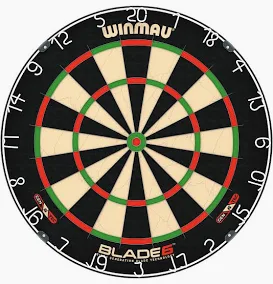
In the 501 game of darts players take turns at throwing 3 darts to reduce their score to zero.
A “checkout” refers to the process of finishing a game by reducing a player’s score to exactly zero, by hitting a double or the bullseye (50 points) with the final dart.
For example, if a player has 40 remaining, they can hit the double 20 (D20) to win.
The maximum checkout is 170. How can you make this?
For which numbers between 140 to 170 can you find a three dart checkout?
140
150
160
141
151
161
142
152
162
143
153
163
144
154
164
145
155
165
146
156
166
147
157
167
148
158
168
149
159
169
Most darts players like to aim to finish on D20, D18, D16 or maybe Bullseye.
A player has 94 left with three darts. They aim for T18
What is their checkout if they hit T18?
What is their next dart if they hit a single 18 instead?
Imagine you have three darts. Would you rather a score of 32 or 30 left? Think about what happens if you just miss D16 and get single 16 left versus just missing D15 and getting single 15.
What checkouts can you find for three darts on 107? What would be the best option do you think?