
Did you know genuine snowflakes have six fold symmetry? We learnt this and more using the resources by Matt Parker here.
Did you know genuine snowflakes have six fold symmetry? We learnt this and more using the resources by Matt Parker here.

Today we worked on all our Christmas cracker puzzles.

Today we looked at ways to count on our fingers. Up to 10 is obviously straight forward, but can you do better?
We managed 1023. Can you work out how? Can you do better?
This idea came from a great maths book – Things to Make and Do in the Fourth Dimension This website link has lots of gadgets to play with.
SAMI (Supporting African Maths Initiatives) supports mathematics work across Africa, including coordinating volunteers and resources to help run yearly maths camps in Kenya, Ghana, Ethiopia and Tanzania, as well as weekly maths clubs in over 70 schools. SAMI has also helped to raise money and lend expertise to developing computer programs for statistics and education, as well as providing tablets and training to help improve livelihoods for people living in rural African villages. With some extra funding SAMI could extend their projects to more schools and communities in more countries, and travel to the most isolated areas where their support is needed most.
See here for more information about SAMI. Donations are very welcome here.
Enjoy the puzzles, Merry Christmas.
Santa can wrap all the presents in 60 minutes and Mrs Claus can wrap all the presents in 40 minutes.
How long will it take them if they do the job together?
Solution is here.
Take the total amount of presents as x. Santa will be working at a rate of x/60 presents per minute, and Mrs Claus at a rate of x/40 minutes.
By simply adding the rates together,
x/60 + x/40 = 100x/2400 = x/24,
we can find the answer, 24 minutes.
Children are sitting in a circle, and a teacher walks around the circle, giving presents. The teacher gives a blue present to every second child, and a green present every third child.
After going around four times, the sixth child from where the teacher started has two blue present and two green presents.
What is the fewest amount of children could there be?
Solution is here.
The teacher goes round the circle four times. If there was an even number of children, the sixth child would always receive a blue present and would have four blue presents at the end. Since they only have two blue presents, there must be an odd number of children in the circle.
With the same logic for the green presents the answer can’t be a multiple of 3.
The sixth child receives a green present in the first round because 6 is a multiple of 3. She only receives one more green present so the answer can’t be a multiple of 3.
The options are 7, 11, 13, 17, 19 … and so 7 is the fewest number of children.
Three bells ring on Christmas Day.
The first bell rings every 6 minutes,
The second bell rings every 14 minutes,
The third bell rings every hour.
If all the bells ring together at noon, at what time will they next all ring together?
Answer is here.
The lowest common multiple of 6, 14, and 60 is 420 (7×6×10). So 7 hours after noon.
7pm is the answer.
Matt, Noah, Olivia and Penny are at the Christmas market.
A Christmas tree seller is selling decorated and undecorated trees.
There is one more decorated tree than undecorated tree.

Matt says that the number of decorated trees is prime.
Noah says the total amount of trees is more than 8 and less than 12.
Olivia says that there are 4 undecorated trees.
Penny says that Olivia or Noah are lying.
Only one of the four are lying.
How many trees are there?
Solution is here.
There must be 4 decorated trees and 5 not decorated.
The first assumption that can be made is that either Penny, Olivia or Noah are lying, because if Penny is lying, everyone else is truthful, and if Matt is lying, Penny states that Noah or Olivia are also lying, so either one of those three are lying, which means there are too many liars.
Therefore, we have two truths: there is one more decorated tree than undecorated, and the number of trees is prime, what Matt says. Starting with all primes smaller than ten, there could be 2 undecorated and 3 decorated trees, 4 undecorated and 5 decorated trees, or 6 undecorated and 7 decorated trees.
If Olivia is telling the truth, the total is 9 (4+5) , which also means that Noah is telling the truth ( 8 < 9 < 12), and Penny is lying. In the other cases, both Noah and Olivia must be lying at once(2+3 < 8 and 6+7 > 12, none of these possibilites contain 4).
The only possible solution is when Penny is lying, and we’ve seen that in this scenario, there are 5 decorated trees and 4 undecorated trees.
You could solve this by simultaneous equations, but there is a quick way to do it without working out how much each present costs.
Add together all the amounts – this will give you double the cost as each colour present appears twice. Then just divide your answer by 2.
(£22+£15+£16+£32+£37)/2 = £61
 Five presents were bought for Christmas
The red and purple presents together cost £22
The purple and blue presents together cost £15
The blue and gold presents together cost £16
The gold and green presents together cost £32
The green and red presents together cost £37
What is the total cost of all 5 presents?
Solution is here.
The possibilities are:
(Wins, draws, goals)
Rudolphs: (0, 0, 8) or (0, 1, 3)
Comets: (0, 0, 14) or (0, 1, 9) or (0, 2, 4) or (1, 0, 4)
Vixens: (0, 0, 9) or (0, 1, 4)
If there were 3 games, then there would be 30 points
for wins and draws, leaving just 1 point for goals,
so that is not possible, since each team scored in each game.
Thus, there were only 2 games,
yielding 20 points for wins and draws, 11 for goals,
which reduces the possibilities to
Rudolphs: (0, 1, 3)
Comets: (0, 2, 4) or (1, 0, 4)
Vixens: (0, 1, 4)
Rudolphs had a draw (and maybe a loss).
Comets had 2 draws or a win and no other match.
Vixens had a draw (and maybe a loss)
If Comets had 2 draws, then both games were draws,
but that is not possible since total goals was 11, which is odd.
So Comets had a win against one of the others,
and the other game was a draw between the Rudolphs and the Vixens.
The score of Rudolphs-Vixens draw then was either 1-1, 2-2, or 3-3
Since Vixens scored more goals than Rudolphs, they
are the ones who lost to Comets, and Rudolphs, only playing once,
scored all 3 goals in that game, equalling Vixens.
Comets scored all 4 of their goals in their only game, where
Vixens scored one additional goal.
The results were:
Comets 4, Vixens 1
Rudolphs 3, Vixens 3
Snowman had never fully understood the points system in football, and felt that the scoring of goals should be encouraged. His idea is that 10 points should be awarded for a win, 5 points for a draw and 1 point for each goal scored, whatever the result of the match.
This was tried with three teams: Rudolph, Comet and Vixen.
Each team scored at least one goal in every match and no team played another more than once.
Rudolph scored 8 points, Comet 14 points and Vixen scored 9 points.
Find the score in each match.
Solution is here.
It can be proven that there are no integer (whole number) solutions to
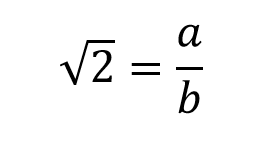
So there are no integer solutions to
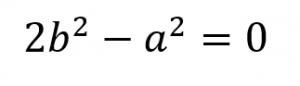
But can you find positive integer values of a and b that nearly work? That give the answer 1 or -1?
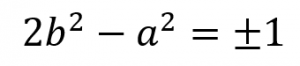
Can you find a pattern to all your solutions?
What does a/b give a good approximation to?

Today we worked on this fun puzzle from Mathpickle.com.
You can work through the website at your own pace, but make sure you don’t read beyond the slide below until you have tried it yourself (Spoiler alert!).


This week we looked at an online simulation of the Galton board (or Bean Machine), which is a device where beads are dropped from a funnel at the top through ranks of nails.
Each time a bead strikes a nail it has a 50% chance to veer left and a 50% chance to veer right.
Each bead eventually drops in one of the column A, B, C, D or E.
1. Do you think the probabilities for a bead to land in A,B,C,D or E are equal ?
2. If not which column has the highest probability ?
3. Can you do a computer simulation of 10,000 beads dropping in a Galton
board using scratch or Python ?
When you throw two dice and add the numbers together what number are you most likely to get? What is the smallest number you can get? What is the biggest? Are all numbers equally likely?
We used python to simulate rolling a dice 100 times and plotted the results using pygal. Step by step instructions are here.
A big challenge would be to program the following game on python:
The game of Pig is a two player game played with two six-sided dice. The object of the game is to reach 100 points of more. Play is taken in turns. On each person’s turn that person has the option of either:

We really enjoyed working on the following puzzle from Nrich.
Thirteen nations competed in a sports tournament. Unfortunately, we do not have the final medal table, but we have the following pieces of information:
1. Turkey and Mexico both finished above Italy and New Zealand.
2. Portugal finished above Venezuela, Mexico, Spain and Romania.
3. Romania finished below Algeria, Greece, Spain and Serbia.
4. Serbia finished above Turkey and Portugal, both of whom finished below Algeria and Russia.
5. Russia finished above France and Algeria.
6. Algeria finished below France but above Serbia and Spain.
7. Italy finished below Greece and Venezuela, but above New Zealand.
8. Venezuela finished above New Zealand but below Greece.
9. Greece finished below Turkey, who came below France.
10. Portugal finished below Greece and France.
11. France finished above Serbia, who came above Mexico.
12. Venezuela finished below Mexico, and New Zealand came above Spain.
We came up with different strategies to sort out the medal table, and we were largely successful eventually, but we were all impressed by a quick way to solve it!

We played a two player strategy game today, using all the information from +plus magazine.
The game is played as follows. At the start of a game each player decides on their three colour sequence for the whole game. The cards are then turned over one at a time and placed in a line, until one of the chosen triples appears. The winning player takes the upturned cards, having won that “trick”. The game continues with the rest of the unused cards, with players collecting tricks as their triples come up, until all the cards in the pack have been used. The winner of the game is the player that has won the most tricks. An average game will consist of around 7 “tricks”.
e.g. Player 1 picks RRB, Player 2 picks RBB and see who wins.
The question we thought about was:
There is a related game called Penny’s game, using Heads and Tails of a coin toss instead of playing cards. In this version, you just play until one person has won a “trick”. We worked out some of the odds given in the first table in this article.
We ended up having to sum a geometric series! Great fun!

Welcome back everyone!
Our first puzzle this year was to place 8 queens on a chessboard such that none of the queens could take any of the others. Above is a fail – only 5 queens are on the board and they are no places left to put any more.
Here is H.B.Meyer’s website – try for yourself to fit 8 queens on the board, it is possible!
We then looked at changing the size of the board from an 8 by 8 to smaller sizes, e.g. can you fit 5 queens on a 5 by 5 board? Here is a place to try this. And if so, how many “unique” solutions are there? We defined a unique solution as being one that did not look like any others we had found when we rotated our paper or put it up to the light so it appeared flipped!
There is a great numberphile video on this puzzle, and all the answers for different size boards on wikipedia.
On a piece of paper, draw a triangle (any triangle -right angled, equilateral, isosceles, scalene). Colour one of the vertices red, the second blue, and the third green.
Next, take three dice – one red, one blue, and one green.
Now draw a point in the triangle. This point is the seed for the game. Then roll the die. Whichever die shows the highest number (throw again if there is a tie for the highest), draw a point halfway inbetween the seed and the appropriately colored vertex. Now do the same, using your new point as the seed for the next. After a few rolls you might have a drawing like this:

Now continue in this fashion for five rolls of the dice. Then rub out all the points except the most recent seed and the coloured points.
Now carry on but don’t erase any points.
Can you guess what pattern your points are going to make? You might be surprised!
You might want to use technology to help you find out. Here are some instructions for using geogebra.

The aim of this puzzle is to switch the red frogs with the blue frogs according to the following rules:
How many moves does this puzzle take?
How about if we change the number of frogs? Can you find a rule for the number of moves it will take based on how many frogs there are?
NRich has an applet with nice graphics here, but you are allowed to go backwards in their version, so it is is best to use this one to help you count the moves.
For interested facilitators extra notes and the solutions are here.

Today we solved an intriguing homework riddle with the help of a Venn diagram. We had clues such as
“Seven students in total have Maths homework but Miya isn’t one of them.”
and
“Rory has more homework than Aidan.”
Using all the clues, which you can find here, we were able to work out which students had which pieces of homework.
It was a nice challenge! The solution can be found here. This activity was originally found on the TES website.

We spent this maths club playing the highly addictive game Square it from Nrich.
This game is thanks to David Bedford at the BCME Conference in Warwick.
One person writes down a polynomial with positive integer coefficients. Call it f(x) They then choose an integer that it bigger than all their coefficients. Call it n. They then calculate f(n) and give just n and f(n) to the second person.
The second person should be able to name that polynomial! How?
Example:
Given only n=8 and f(n) = 6855 how could you work out that the polynomial was
 ?
It might help to think about an example when n=10 first.
Hello everyone … we hope you will enjoy working on the problem below from the UK and Kenya! Please post your comments below.
First think of an integer written out in letters e.g. sixteen.
Take the number of letters in this number e.g. 7
Write this number out e.g. seven
Take the number of letters in this number e.g. 5
Write this number out e.g. five
Take the number of letters in this number e.g. 4
Write this number out e.g. four
Now we have converged to the number four.
Try this process with other numbers and see what happens.
Is it the same in other languages?
You may want to use the power of Python programming language to explore this further. You can make the Trinket below fullscreen by clicking on the three parallel lines in the top left corner and then clicking fullscreen (and do this again to stop it being fullscreen).
… will the 28th of July 2061 be? (Next predicted sighting of Halley’s comet)
… was the 4th of April 1965? (Robert Downey Jr ‘s birth)
… was the 17th of July 1789? (Prise de la Bastille)
We puzzled over these two questions having to think about where to start, the number of days in each month, and the rules for leap years.
It was fun to try different strategies by hand, but then we used the mod function and the floor function in Zeller’s algorithm to find quickly the day of the week for any date.
