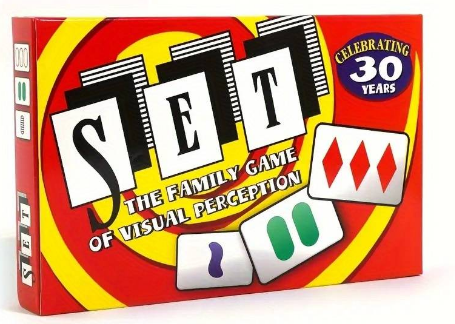
We played the great game of SET and then answered these questions. The answers can be found in this document from The Madison Math Circle. Thanks to them and David J Bruce for the ideas.
We also started to think about how to represent cards in a geometric space. If you take a simple game of set with just two characteristics, you can plot each card in 2D and hence work out how many cards you can have on the table before you make a set (by not drawing a straight line). See here for the details.
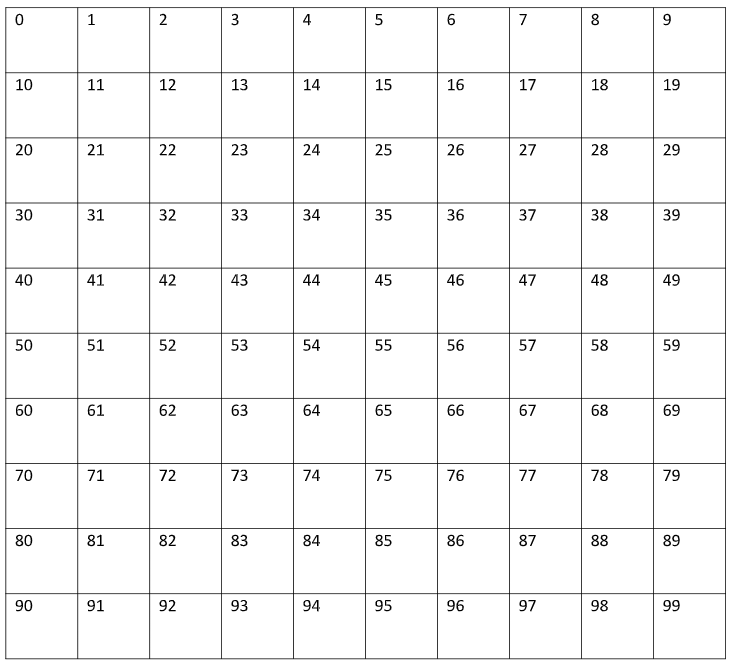
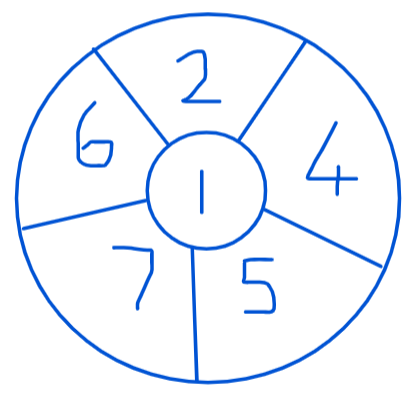
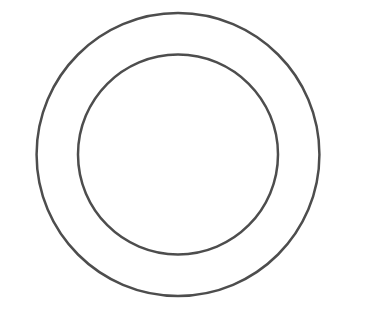
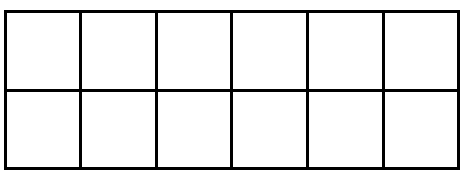
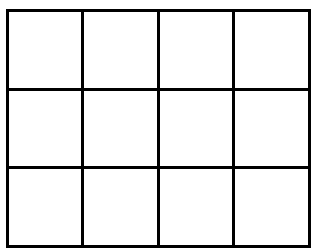
The Irish logarithm is an algorithm invented by Percy Ludgate in 1909 for multiplying single-digit numbers. The idea was to program a computer to do these calculations. The algorithm uses two tables to perform the multiplication. With just these tables you can calculate products up to 9×9 simply by adding two numbers together.
Here are blank versions of the two tables below (and as a pdf).
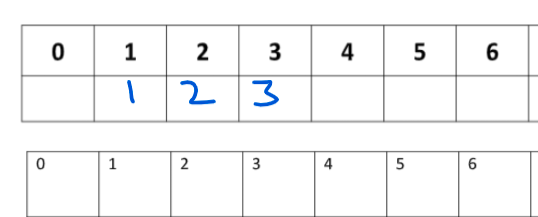
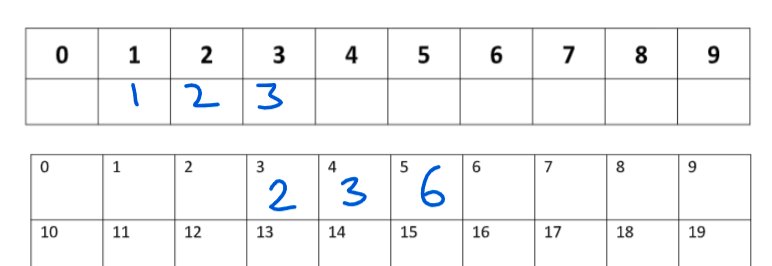
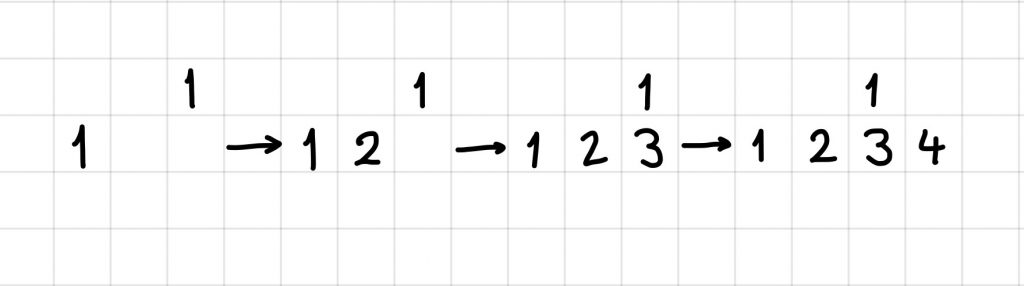
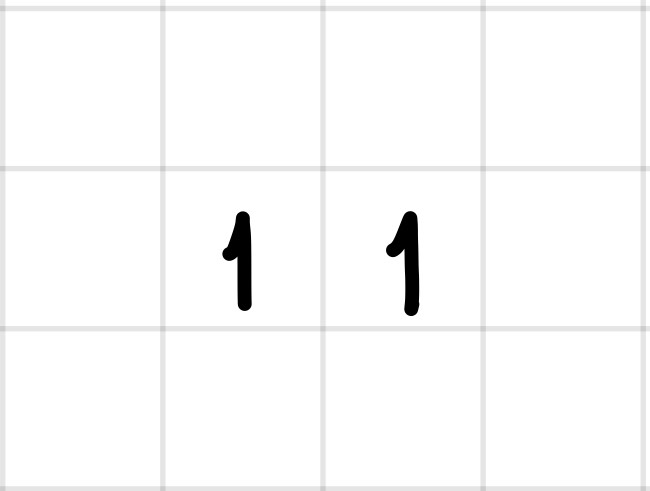
Our challenge was to fill in these tables. Here is the start of an attempt that would not work …
1 x 2 would be 1+2 so the correct answer of 2 needs to be in the box called 3.
1×3 would be 1+3 so the correct answer of 3 needs to be in the box called 4.
2×3 would be 2+3 so the correct answer of 6 needs to be in the box called 5.
So far so good ….
But … 2×2 would be 2+2 so the correct answer of 4 needs to go in the box called 4. But the box called 4 already has a 3 in it, so our initial choice of numbers is a bad one.
Can you do better?
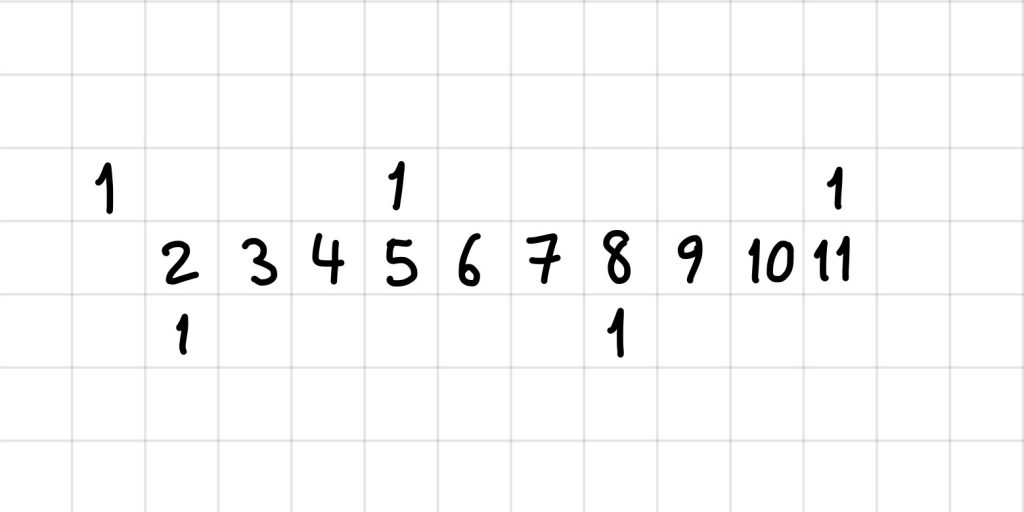
It is very difficult to come up with the solution from scratch (but do try!). Here are a few numbers already filled in, if you would like a starting point (and as a pdf).
A tiling consists of covering a surface (a plane) using copies of shapes, called tiles, without overlapping or leaving gaps.
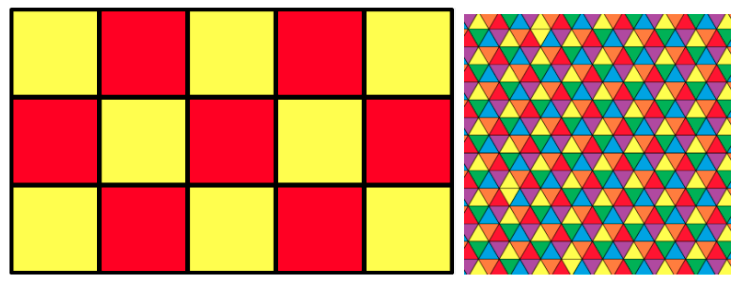
For example if we use a square or an equilateral triangle as a tile we can create a tiling that will cover an infinite plane.
Only one other regular (all sides and angles the same) polygon can tile the plane, which polygon is this?
Can you prove that there are no others?
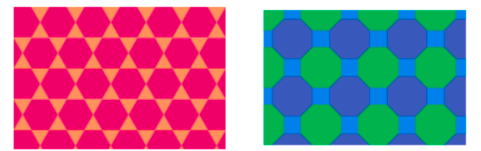
You can also use multiple shapes to tile the plane. For example:
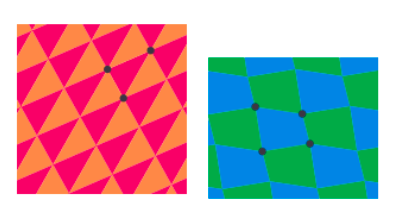
You can also use irregular shapes to tile the plane, any triangle or quadrilateral works:
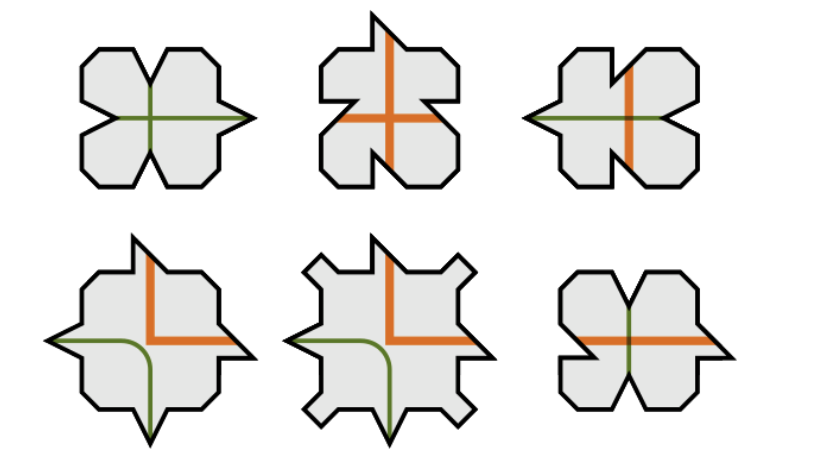
Exactly 15 different pentagons will work, for example:
Go to Mathigon and make a tiling using either one regular polygon, one irregular triangle or quadrilateral or multiple shapes. Use the “Polygons and Shapes” or Pentagon Tilings” menus. You can change colour at the bottom.
All the above tilings are periodic tilings which means they have translational symmetry.
Aperiodic Tiling
Go to Mathigon and make a tiling using either one regular polygon, one irregular polygon or multiple shapes.Use the “Polygons and Shapes” or Pentagon Tilings” menus. You can change the colour of the tiles at the bottom and you can quickly duplicate whole sections of your tiling by highlighting and clicking on the copy icon.
All the above tilings are periodic tilings which means they have translational symmetry.
From wikipedia:
Covering a flat surface (“the plane”) with some pattern of geometric shapes (“tiles”), with no overlaps or gaps, is called a tiling. The most familiar tilings, such as covering a floor with squares meeting edge-to-edge, are examples of periodic tilings. If a square tiling is shifted by the width of a tile, parallel to the sides of the tile, the result is the same pattern of tiles as before the shift. A shift (formally, a translation) that preserves the tiling in this way is called a period of the tiling. A tiling is called periodic when it has periods that shift the tiling in two different directions.
The tiles in the square tiling have only one shape, and it is common for other tilings to have only a finite number of shapes. These shapes are called prototiles, and a set of prototiles is said to admit a tiling or tile the plane if there is a tiling of the plane using only these shapes. That is, each tile in the tiling must be congruent to one of these prototiles.
A tiling that has no periods is non-periodic. A set of prototiles is said to be aperiodic if all of its tilings are non-periodic, and in this case its tilings are also called aperiodic tilings.
In 1961 Robert Berger constructed such a set, using more than 20,406 tiles. Later he found a much smaller set of 104, and Donald Knuth was able to reduce the number to 92.
Then Raphael M. Robinson found this set of 6 tiles in 1971:
And finally in 2022 a retired systems printing engineer found a single tile – called an Einstein tile for the German for one stone.
A Penrose tiling uses only two shapes, with rules on how they are allowed to go together. These shapes are called kites and darts and in the mathigon version they have white lines that need to match up. This means for example that the dart cannot sit on the kite. Three possible ways to start a Penrose tiling are:
These are called the ‘star’, ‘sun’ and ‘ace’ respectively.
Using the pictures above, can you calculate all the angles in the dart and the kite?
There are 4 other ways to arrange the tiles around a point. Can you find them all?
Oxford Online Maths club have done a nice video on this topic. Roger Penrose is a famous professor at Oxford and has a floor built in his honour with his tiles:
We found this activity on Nrich and it was originally in one of Brian Bolt’s books and developed by MEDIAN in their collection of interesting number resources.
This Daisy is special because you can make every number from 1 to 25. You are only allowed to add neighbours (numbers touching each other) and you can only use each number once in a sum.
Can you do better than this with a different set of numbers? The challenge is to find six numbers to go in the Daisy from which you can make all the numbers from 1 to a number bigger than 25.
You can check your ideas here:
Could you adapt the program above to search for a higher solution?
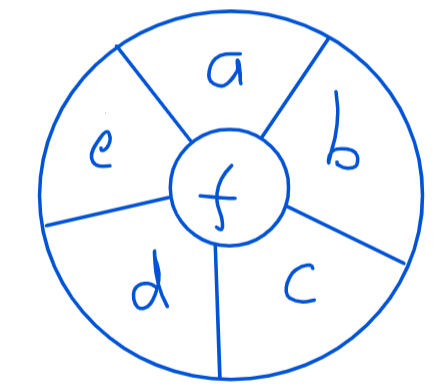
To write the program above we needed to find all the combinations from a general daisy like this:
For example you can have a+b or a+f but not a+d. Can you find all the combinations? There is a worksheet to fill in here (with the solution on the second page). An editable version is here.
On the 10th of October we engaged in an activity in which thousands of students around the world were concurrently engaged.
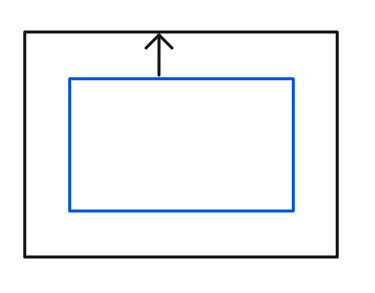
First, pick a rectangle in the room (e.g. table, computer screen, piece of paper). Take a piece of string and make it the length of the perimeter of the rectangle plus one metre.
Now try and hold the string around the shape so that you have made a path of equal width around the shape. How wide is your path?
We did this practically and then resorted to pen and paper to find exact widths for different sized starting rectangles.
Amazingly we all found the same width …
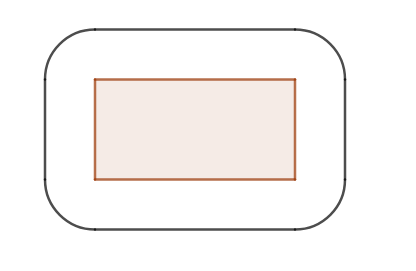
We then tried the same puzzle but keeping the path the same width all the way round the shape:
Finally we tried with a circle
which led to us being able to understand the answer to this classic puzzle:
Imagine that the Earth is a perfect sphere and imagine we have a large piece of string tied around the equator.
We then add one meter to the length of the string so that now the string is hovering above the equator, still in a circle.
What is the size of the gap between the equator and the piece of string? Enough to fit a piece of paper under? A cat? A car?
You are given two lives to guess my number (which is between 1 and 100 inclusive).
If you guess too high you lose a life.
For example …
I’m secretly thinking of the number 42. If you guess 50 you lose a life. If you then guess 45 you lose your final life and you have failed.
After guessing 50 and losing a life you would then have to guess 1, guess 2, guess 3 and so on until you correctly guess 42. So this would work but would take a long time.
What strategy should you use to minimise the number of guesses it takes to guess my number? And what is the worst case scenario for how many guesses it could take?
If you are familiar with the two eggs problem it is essentially the same puzzle!