Welcome back to Maths Club! We are so happy to be able to get together again in person.
Today we tried this puzzle from the SAMI VMC playing card deck
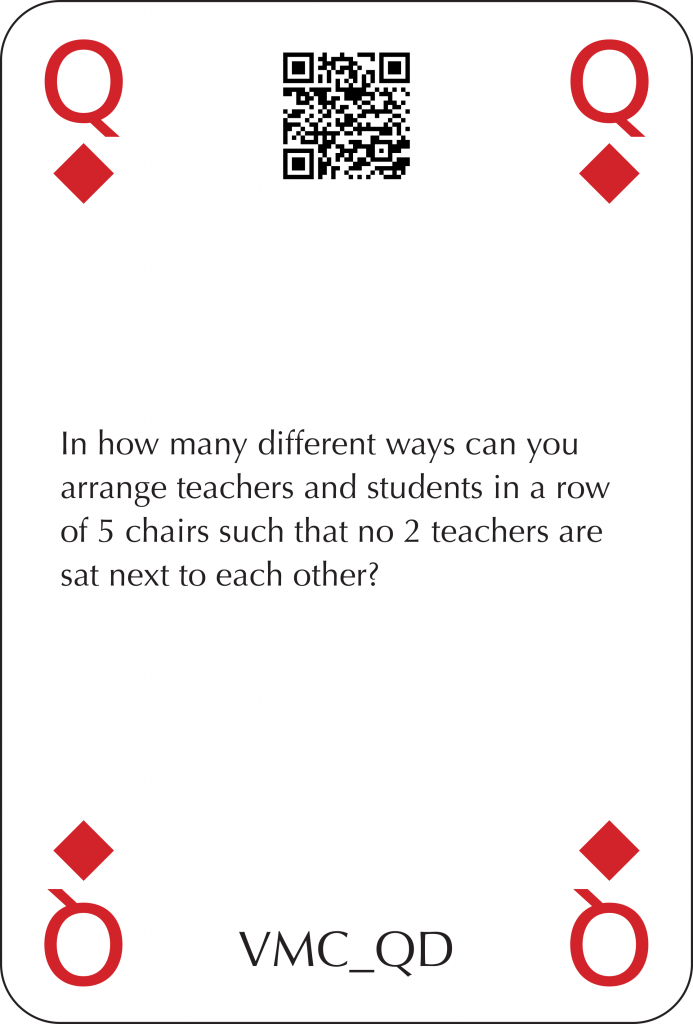
For a hint, the solution and extensions see here.
Select the 16 Jacks, Queens, Kings and Aces from a pack of cards. Try to put them in a 4 by 4 square so that each rank (J, Q, K, A) and each suit (Clubs, Diamonds, Hearts, Spades) appears only once in each row and column.
This puzzle is an example of a Latin square. Latin squares are used in medical trials to ensure every participant is allocated to each treatment for the same time period to prove which is the best treatment. See these links for some more info – mathsisfun, wikipedia and nrich.
We are really missing having maths club in person, and we missed the maths camps in Africa in the summer … but we are so happy that circumstances have meant the launch of the Virtual Maths Camp. The puzzle above is going to appear on the 6 of spades in our card deck! Please check out the idea behind our maths club app which can be accessed online here. We are very keen to translate our activities into French so that they can be used in countries like Togo. If you would like to help with translation, please get in touch with Emily Fleming at [email protected].
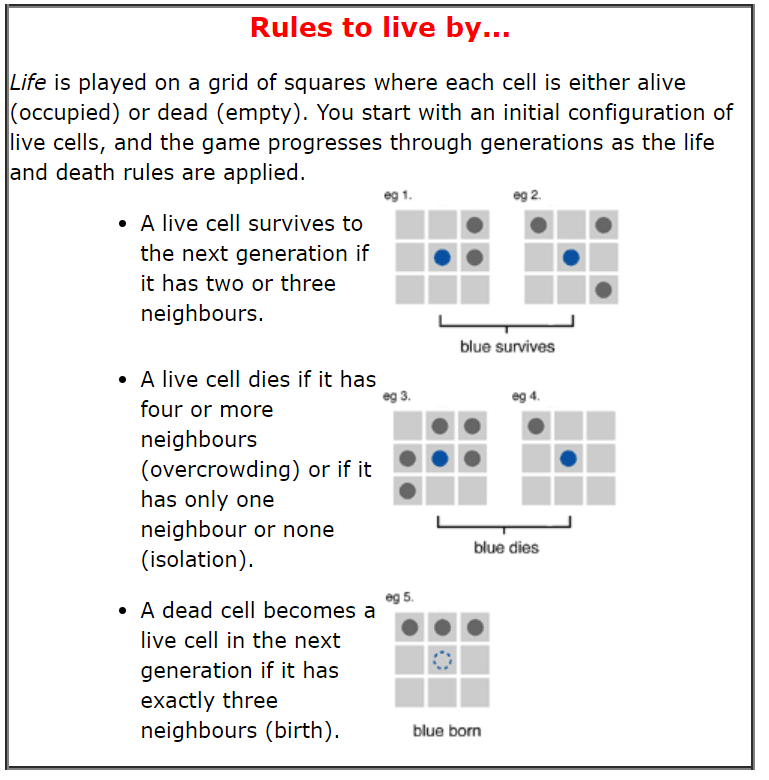
Go to this https://bitstorm.org/gameoflife/ and colour in a 2 by 2 square on the screen like this:
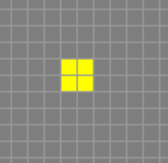
Press start. Nothing should happen to the square. Why?
Well, because each yellow square has exactly 3 neighbours so all survive. There are no other cells that have exactly 3 neighbours so no new cells are born.
Now try with a three by three cell:
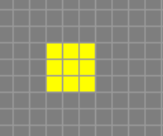
Press start. What happens?
Try to work out on paper what you think would happen for a 4 x 4 shape.
Then test your answer.
How about 5 x 5, 6 x 6 and 7 x 7?
Have a play around and see what fun patterns you can make.
You might like to read the article from Plus Maths or even try this question from the 1996 British Informatics Olympiad.
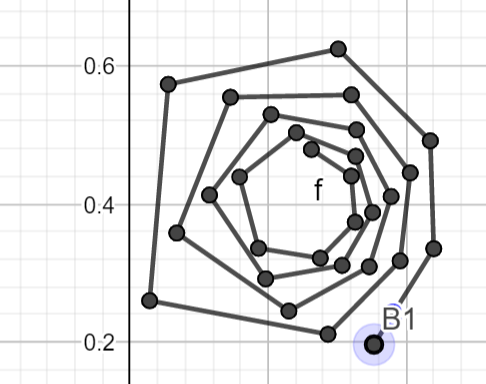
Here are some instructions to try to understand this fascinating set of numbers.
Try the tasks on pen and paper Geogebra, and then watch the video by Ben Sparks …
Two amazing videos to share with you this week from Tadashi Tokieda. Try them out at home!!
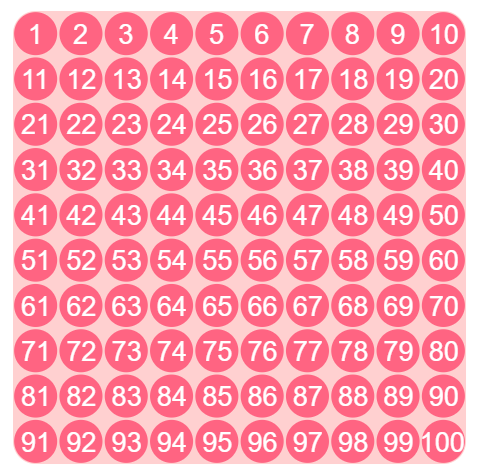
Today we worked on this lovely puzzle from Nrich.
Choose a starting number from a 1-100 square and cross it out.
Then choose a factor or multiple of that number.
Keep crossing out factors or multiples of the last number in the chain.
For example, Charlie started with 60, 30, 6, 96, 16, 32, 8, 56, 7, 21, 42,…
What’s the longest chain you can make?
There is an interactive place to play here
When you are using the activity make sure you only have a bracket at the start and the end … this attempt isn’t quite right:
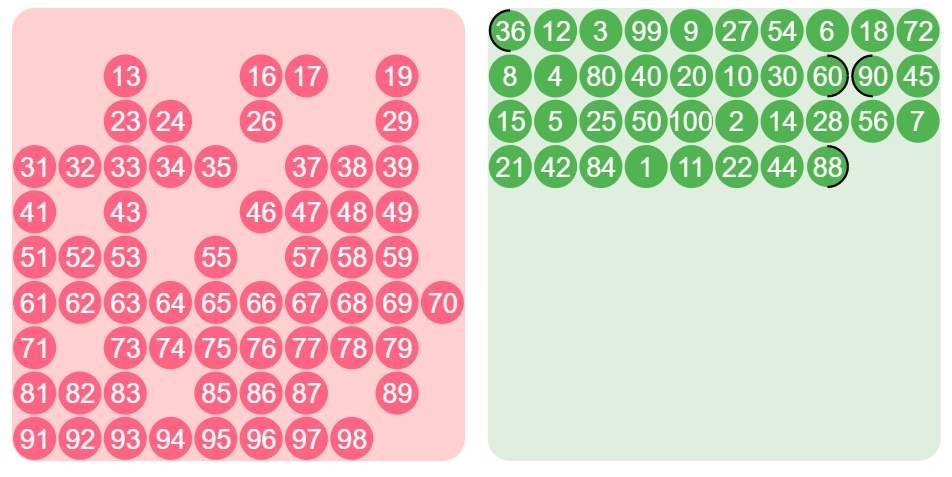
But it can be fixed by swapping the 60,90,45 and 15 around:
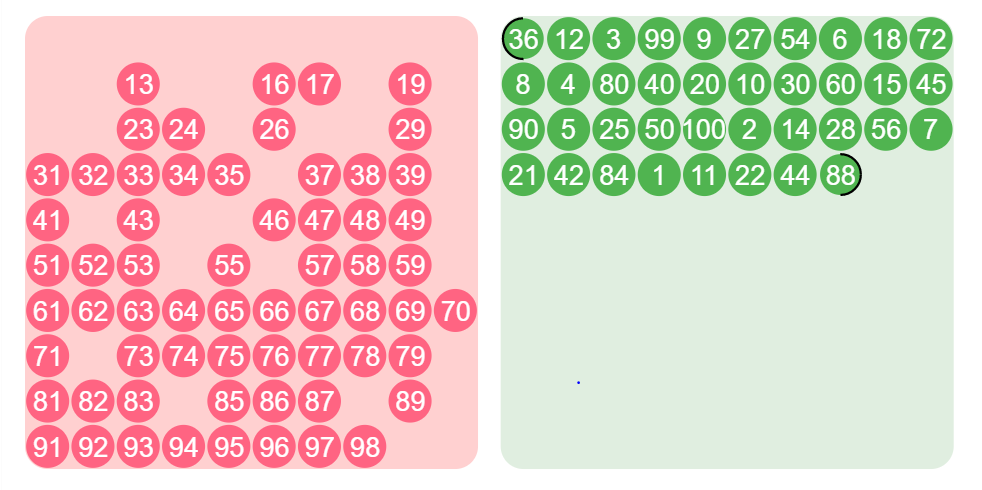
Email Mrs Fleming on [email protected] if you can do better than 38 steps …
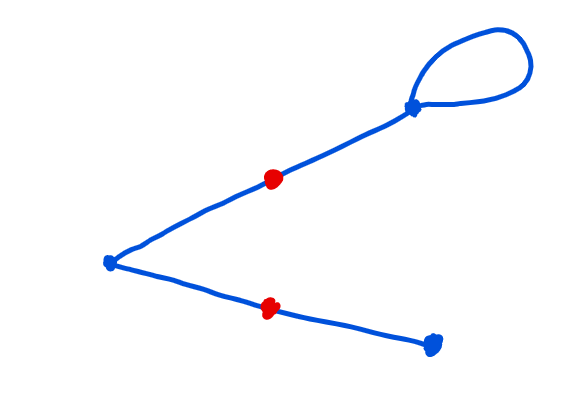
In honour of John H. Conway, today we present a game that he co-invented with Michael S. Paterson while they were both at Cambridge.
It is called Sprouts, and the rules are summarised by Nrich here.
Anyone can play, so find someone in your house and play a few games, then try and discover some of the maths behind it by working through this article.
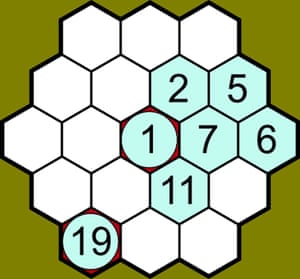
Can you fill in the numbers 1 – 19 so that there is a continuous path through all the numbers from 1 to 19?
The inventor of Hidato puzzles is Gyora Benedek. Read all about him and see more puzzles (printable and interactive) in Alex Bellos’ column in the Guardian.
Ben Sparks gives instructions to do some disease modelling on Geogebra – so you can see the maths behind the government advice to “flatten the curve”. Geogebra is available here. When you try and recreate the applet, don’t worry if the first three numbers appear as sliders, it will still work fine.
Also, see the message below from the Think Maths website we have enjoyed in the past:
“Matt Parker has launched Matt Parker’s Maths Puzzles! Once a week we can now look forward to a puzzle video from Matt on his Stand-Up Maths YouTube Channel.
Each week Matt will give us a puzzle and pose a question. Viewers can submit their solution to that question online to receive points and appear in a puzzle participants league table.
Matt will be awarding hilarious virtual prizes when participants reach particular point milestones.
The first puzzle video is here. Submit your answer here: www.think-maths.co.uk/table-puzzle
We aim for puzzle videos to be released on a Wednesday afternoon UK time, with the deadline for submissions the Tuesday of the following week at 11:59pm UK time.
Sign up to recieve an alert email when puzzle videos come out here: https://www.think-maths.co.uk/puzzles-sign-up
On Fridays we will post a solution video to the previous week’s puzzle and the updated league table on this page: www.think-maths.co.uk/maths-puzzles“
Take care everyone.